Dig This
How a movie, a museum, a LinkedIn post and 60 open tabs turned into a fully working website in under 24 hours.
Crate digging for the internet meets Pinterest on steroids.
Something I would have loved to build for the better part of twenty years and never would have had the time, the team or the budget to build now exists. I built it in about 24 hours, in between client work, dinner, bedtime and a few appointments, mostly by talking to an AI agent from my car and my couch. That includes the article you’re reading.
I want to tell you how that happened, because I think the how is the interesting part. We’re in a genuinely strange and exciting moment, where the distance between “wouldn’t it be cool if…” and “here, try it” has collapsed to roughly the length of a day. And the thing I built happens to be a tool for exactly the kind of person who has too many of those ideas.
Exhibit A

That’s one window. There are others. The number of open loops I create in a day is honestly a little insane.
There’s a well-known idea in psychology called the Zeigarnik effect¹. The story goes that a young researcher named Bluma Zeigarnik noticed that waiters in a Berlin café could remember every detail of an order while the bill was still open and then forgot it completely the moment it was paid. Unfinished things stay lit up in your head. Finished things get to go dark.
Every one of those tabs is an open bill.
I’m a collector. A researcher, a note taker, a noticer. I have journals everywhere. I text myself links at all hours. I’m always reading, learning about how to design and build websites, how to run a business, how to write copy, history, philosophy, music, whatever rabbit hole opened up that morning. My problem has never been a shortage of ideas. I’m something of an idea factory. My problem is getting them down, grounding them and figuring out which ones actually deserve my attention.
For someone like me, building the infrastructure to hold all of that isn’t a nice-to-have. It’s how I stay grounded instead of lost. And I have a lot of empathy for anyone who struggles with the same thing, whether you’re a designer, a founder, a student, a parent researching curriculum or someone with a great idea for a side hustle and forty tabs about it.
How I vibe coded a working website in under 24 hours
Here’s the timeline, more or less as it unfolded. Tap any line to open it.
I text myself a museum
I stumble onto the Museum of the Human Web, a beautiful, scroll-driven history of the web made by Parallel². It sends me down a rabbit hole about how the internet has changed and how it was built.
“build watchlist”
I send myself a YouTube interview with Mazdak Sanii on building Avant Arte³, a company I’ve been tracking, with a two-word note: build watchlist. I don’t watch it. I just know I need somewhere better to put things like it.
Screenshot-driven product design
I listen to Alexandr Wang talking about building at Meta⁴, including the idea of designing products from screenshots. It lands, because that’s how I work too: screenshots everywhere, sent to myself, to friends, to my agents.
Emmett Shine posts
Emmett Shine shares the new site Little Plains⁶ built for Permanence Bio, about how you visualize the story of repair. The scroll animation stops me cold. How does that work? What typeface is that? Who made it?
A working prototype
An hour and a half later there’s a working concept on my lab site: paste a link and see what a website is made of. I text myself the link and go back to my actual job.
Prompting from the car, building after bedtime
On the drive home I’m prompting by voice. After dinner and after the kids go down, I spend about two and a half hours building it out with my agent. By 11:45 pm I have a profile page.
Riffing in the car
A few more hours this morning, much of it voice-to-text between appointments, riffing on what would make it great. I sketch a simple illustration in Illustrator. Sign-in, crates, email, an admin and an agent connection go live.
This article
Written the same way: me talking, an agent drafting, me rewriting.
Somewhere in there I realized what I was really trying to make: some unholy combination of Pinterest, Mobbin⁷, Godly⁸, StumbleUpon⁹ and Sublime¹⁰, on steroids, with a Chrome extension so you can dig anything you land on, the way StumbleUpon used to let you stumble.
Crate digging
I love music. My studio is surrounded by books and records. I love record stores and Goodwill and the specific joy of flipping through a bin of things nobody else bothered to look at. I love organizing. I remember the first time I saw High Fidelity¹¹ and Rob reorganizing his entire record collection autobiographically, in the order he bought them, so that the only way to find a record is to remember who you were when you bought it.
Dick: I guess it looks as if you’re reorganizing your records. What is this though? Chronological?
Rob: No…
Dick: Not alphabetical…
Rob: Nope…
Dick: What?
Rob: Autobiographical.
Dick: No fucking way.
Rob: Yep. Let me tell ya how I got from Deep Purple to Howlin’ Wolf in just 25 moods. And if I want to find the song “Landslide” by Fleetwood Mac, I have to remember that I bought it for someone in the fall of 1983 pile, but didn’t give it to them for personal reasons.
Dick: That sounds…
Rob: Comforting.
Dick: Yes.
Rob: It is.
That stuck with me. Your collection can be a map of you.
DJs and producers have a name for flipping through those bins: crate digging. You’re hunting for the one drum break, the one horn line, the one weird bar of strings nobody noticed. Then you lift it out and build something new around it. A drum section from a style that shaped you, a melody borrowed from a classical piece, a field recording of rain. Everyone who makes things does some version of this, whether they’re designing a brand, writing a story or starting a company. We study what moves us, we take it apart and we recombine the pieces into something that feels like ours.
DJ Shadow built his first album, Endtroducing....., almost entirely out of other people’s records. “Midnight in a Perfect World” is a mournful piano lifted from David Axelrod’s “The Human Abstract,” layered with pieces of half a dozen other records¹². De La Soul’s 3 Feet High and Rising (1989), made with producer Prince Paul, pulled from funk, doo-wop, psychedelic rock, Steely Dan and Schoolhouse Rock!. Its “Tread Water” floats on a loop from The People’s Choice’s 1971 single “I Likes to Do It”¹³. And Beck’s “Jack-Ass” (1996) is built on Them’s 1966 recording of Bob Dylan’s “It’s All Over Now, Baby Blue”, a Van Morrison band covering Dylan, sampled into something new. None of these songs exist without the digging.
This isn’t just a hip-hop thing. Jonathan Lethem’s essay “The Ecstasy of Influence”¹⁴ makes the case that all art is built out of borrowed parts. Kirby Ferguson’s Everything Is a Remix¹⁵ says it’s true of technology too. Austin Kleon turned the idea into a manifesto, Steal Like an Artist¹⁶. Brian Eno has a word for the bigger version of it, scenius, the genius of a whole scene rather than one lone figure¹⁷. He and Peter Schmidt also made a deck of cards, Oblique Strategies¹⁸, for knocking yourself out of your own habits.
So that’s what dig this. is. Crate digging for the internet:
- You dig the sites, makers and ideas you love.
- dig this. splits them into stems, the way a song splits into drums, bass and vocals: the typeface, the colour, the layout, the motion, the copy, the code and the people who made it.
- You keep them in crates, which are really just playlists you can share.
- You mix stems from different crates into something new.
- And you press the mix into a brief that an AI agent can actually build from.
- DigFind a site, maker or idea
- StemsSplit it into type, colour, motion, copy, code, people
- CrateKeep it with others, like a playlist
- MixRecombine stems into something new
- PressHand it to your agents to build
It’s a little fractal. Crates hold crates, sites hold stems and every stem leads you to every other site that uses it.
And yes, I’m a sucker for Neue Haas Grotesk and a good photocopy texture. I know. I can’t help it.
A little history
I came up with the web. I started at Indiana University in 2005, when Facebook had only just opened beyond the Ivy League and you still needed an .edu address to get in. My first real job in entertainment was in the emerging digital media department at United Talent Agency, from 2010 to 2012. I lost whole evenings to StumbleUpon, checked Metacritic¹⁹ and Pitchfork²⁰ for new album releases and loved the era of great music blogs like Rollo & Grady²¹ out of Los Angeles. Somewhere in all of that I fell in love with the idea of the web as a place you could wander, find strange and wonderful things and pass them along to people you care about.
I’ve been tinkering with that history lately. I built an Era Machine that lets you dial a website back through eight eras of web design. The Museum of the Human Web scratched the same itch from a very different angle. dig this. has a little of that too: every site in the library has a time machine you can drag through its history, straight from the Internet Archive.
I also keep a master spreadsheet, hundreds of rows long, of businesses, studios, companies, creatives and craftspeople I admire. I’ve wanted a better way to see it, to make it modular, to understand the work better and maybe one day collaborate with some of these people. The same goes for the people whose thinking I keep tabs on: Harry Dry²², David Perell²³, Seth Godin²⁴, Dario Amodei’s writing about where AI is headed²⁵ and the people building more human, more cooperative systems, like Metalabel²⁶, Dark Forest OS²⁷ and Retribalize²⁸. Now they live in crates.
People and their agents
Marshall McLuhan called media and technology “the extensions of man”²⁹. Our tools extend what we can perceive, remember and do. I think about that constantly in my work at The Studiolo³⁰, where so much of what I’m trying to do is blend what makes us human, our imagination, our taste, our care for meaningful work, with technology in ways that actually serve those things.
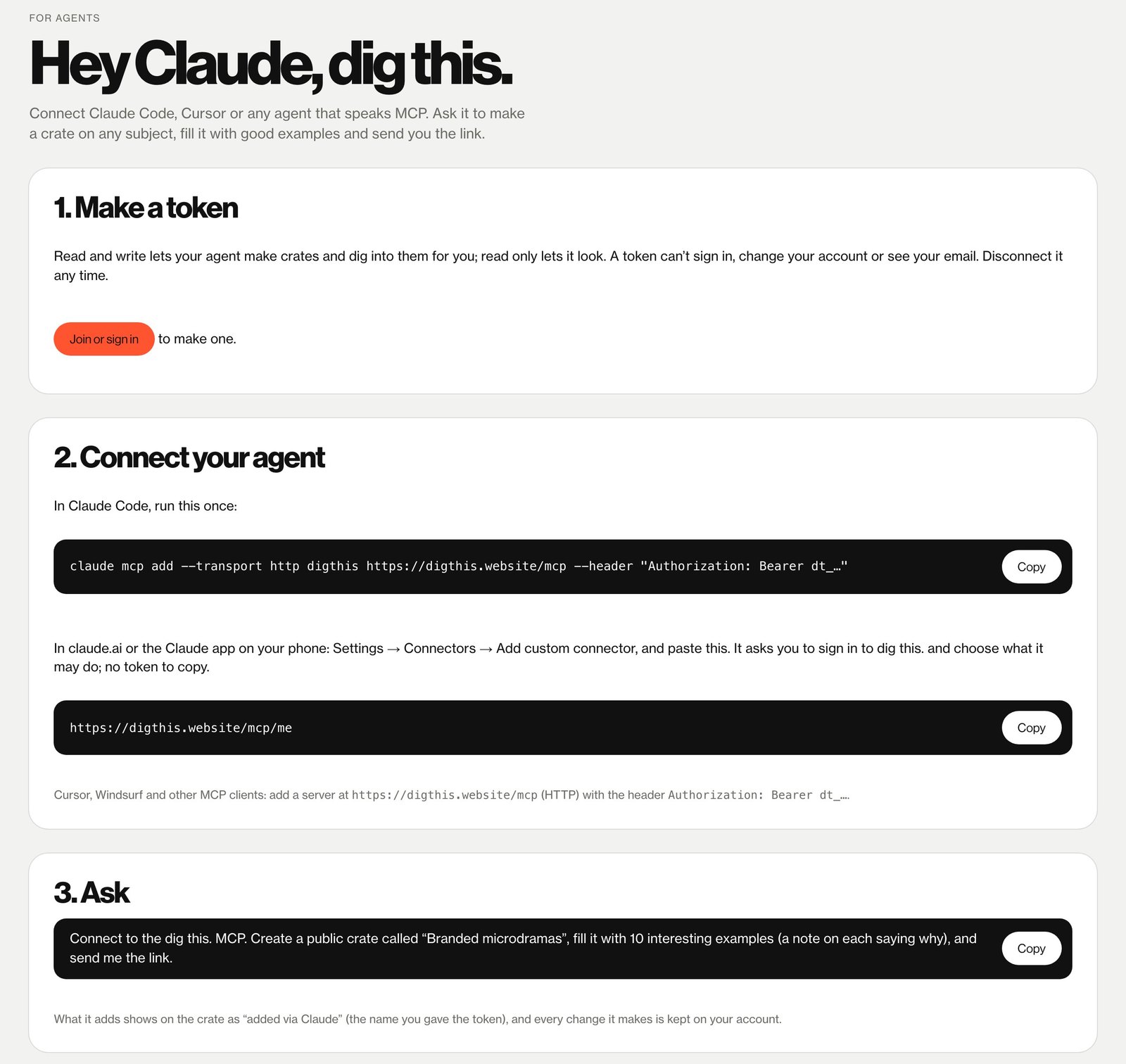
Building dig this. felt like a very literal version of that idea. I worked side by side with Claude Code, sending it screenshots, talking through ideas out loud, pointing it at examples and connecting tools to it through MCP, the protocol that lets AI agents talk to other software³¹. The vision was in my head. The agent helped me get it out into the world while I was still excited about it.
So I built dig this. to be dual native, for people and for their agents at the same time. Every site, crate and member has a card designed to be screenshotted, texted and dropped into a deck. And dig this. speaks MCP itself, so you can say to Claude, “make me a crate of the most interesting branded microdramas, fill it with ten examples and send me the link” and it will. As I write this, that works today in Claude Code with a personal key from your dig this. profile and as a custom connector in the Claude app. That idea, of agentic systems as part of how brands live and work, is one I’ve been watching Little Plains explore for a while³².
Why it matters to me
I don’t want another place to hoard links. I want a reason to share more of them.
To send a friend a crate of recommendations I think they’d love. To finally email someone whose work I’ve admired for years. To meet up with people in person because it turns out we dig the same things. To learn in public, research with some intention and actually come back to the essay I saved for later. To close a few of those open loops or at least give them somewhere to live.
The tabs were never really the problem. The curiosity is good. It just needs somewhere to go.
Try it
It’s free and it’s early, so expect rough edges. Sign up with just your email, no password: digthis.website.
And I’d love to know one thing: what would you make a crate of? Reply, comment, text me. I’m reading everything.
Cheers,
Further reading
- About dig this., the longer version, with how it all works
- Agentic Systems Are the Future of Brands, Little Plains
- Endtroducing....., DJ Shadow’s 1996 album built almost entirely from samples, the high-water mark of crate digging
- “The Ecstasy of Influence”, Jonathan Lethem, Harper’s
- Everything Is a Remix, Kirby Ferguson
¹ The Zeigarnik effect, named for the psychologist Bluma Zeigarnik, who studied it in Kurt Lewin’s lab in Berlin in the 1920s. I’d remembered it as a French study. It wasn’t, but the waiters are real.
² Museum of the Human Web, by Parallel, a company building web infrastructure for AI agents.
³ Avant Arte makes and sells editions with some of the world’s most exciting artists. The interview: Mazdak Sanii: Building Avant Arte.
⁴ Building Muse, Working with Mark Zuckerberg & The Future of AI, Alexandr Wang.
⁵ Digger (2026), directed by Alejandro G. Iñárritu and starring Tom Cruise, Riz Ahmed and John Goodman: “The most powerful man in the world embarks on a frantic mission to prove he is humanity’s savior.” I saw it at the Mariemont Theatre in Cincinnati.
⁶ Little Plains is a creative studio co-founded by Emmett Shine. Their work for Permanence Bio is what started all this.
⁷ Mobbin, a library of real app and web interfaces for designers.
⁸ Godly, a gallery of beautiful websites.
⁹ StumbleUpon (2001–2018) had one button: press it and get a random, often wonderful website picked for your interests. For a while it sent more traffic around the web than almost anything else. Its spirit lives on in dig this.’s Shuffle.
¹⁰ Sublime calls itself “a second brain with a soul.”
¹¹ High Fidelity (2000), directed by Stephen Frears and starring John Cusack, from Nick Hornby’s 1995 novel.
¹² Endtroducing..... (1996), made almost entirely from vinyl samples. “Midnight in a Perfect World” also samples Pekka Pohjola, Organized Konfusion and Meredith Monk.
¹³ 3 Feet High and Rising, often called the first psychedelic hip-hop record. The “Tread Water” sample is noted by Songfacts. A Tribe Called Quest, De La Soul’s Native Tongues partners, did the same on “Electric Relaxation”, built on Ronnie Foster’s “Mystic Brew”.
¹⁴ Jonathan Lethem, “The Ecstasy of Influence: A Plagiarism”, Harper’s, February 2007.
¹⁵ Kirby Ferguson, Everything Is a Remix.
¹⁶ Austin Kleon, Steal Like an Artist (2012).
¹⁷ Kevin Kelly, “Scenius, or Communal Genius”, on Brian Eno’s idea.
¹⁸ Oblique Strategies, Brian Eno and Peter Schmidt (1975).
¹⁹ Metacritic.
²⁰ Pitchfork.
²¹ Rollo & Grady, a Los Angeles music blog I loved. The site is offline now; that link goes to the Internet Archive’s 2019 copy.
²² Harry Dry, Marketing Examples, real-world copywriting and marketing teardowns.
²³ David Perell, writer and host of the podcast How I Write.
²⁴ Seth’s Blog, Seth Godin’s daily posts on marketing and making things that matter.
²⁵ Dario Amodei, The Adolescence of Technology (January 2026) and the earlier Machines of Loving Grace.
²⁶ Metalabel builds what it calls “groupcore” software so creative people can publish, share audiences and split earnings together. Releases include Brian Eno’s What Art Does and The Dark Forest Anthology.
²⁷ Dark Forest OS, “a private internet for creative groups.”
²⁸ Retribalize, matchmaking that connects you with highly aligned people, teams and communities.
²⁹ Marshall McLuhan, Understanding Media: The Extensions of Man (1964).
³⁰ The Studiolo, my human-first design practice.
³¹ Model Context Protocol. dig this. has its own MCP server; the setup is at digthis.website/agents.
³² Agentic Systems Are the Future of Brands, Little Plains.